
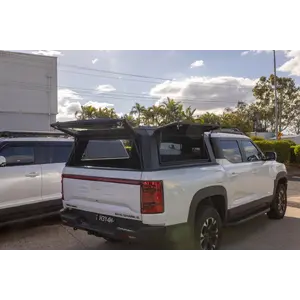
Prepping your ute for serious off-roading means sourcing the right accessories. Stripped-down cab chassis offer the choice of aftermarket trays, with sturdier builds, durable materials, and the option to source custom canopies built to exact specifications. This provides the space and all-around practicality necessary in the bush. The same goes for pick-up cabs, with the single, extra, and dual cabs offering more than their fair share of customisation, albeit somewhat curtailed by the factory tub.
To ensure grip is distributed to all four wheels, OCAM recommends off-roading accessories for a 4x4 drivetrain. The extra axle, locking diffs, and low gearing will get you the traction when trails turn bad and prevent handling issues on loose ground. If you’ve already fitted vehicles with our range of exterior protection, ranging from bull bars and bash plates, and catered to possible emergencies with recovery gear and winches, the next step is to consider the engine performance in harsh Outback conditions.
Why Consider Snorkels?
Snorkels are the off-roading necessity that ensures the engine gets all the clean, filtered air for effortless combustion. This helps when wading through water, tackling sandstorms, and preventing dust particles from messing with the internals.
Connected to the factory air box, and sitting just above the roofline, snorkels increase intake capacity with wider piping, durable reinforced polyethylene or powder-coated stainless steel, front-facing air rams to draw air in higher volumes, and profiles that seamlessly align with the ute bodywork. The parts push more air for improved power when working the pedal, and keep the engine safe from hydrolocking and internal corrosion in demanding driving conditions typical of the Outback.
Choose from the OCAM snorkel line in brushed 316-grade stainless steel for off-roading durability, available for all major ute and 4x4 models, including the Ford Ranger, Toyota Hilux and Prado, the 70, 100, and 200 LandCruiser series, Nissan Navara and Patrol, and VW Amarok.
Or go with snorkels from our Safari 4x4 partners, with the V-spec and Armax snorkels in UV stabilised polyethylene if lower weight and improved corrosion resistance matter more. And consider packages with snorkels and weathershields in the same robust build and colour scheme for matching looks and improved practicality.
General Snorkel Installation Guide
Have OCAM professionals install snorkels on your vehicle. Or do the job yourself. The latter option requires cordless drills with pilot, step and hole-saw bits, files, wrenches, masking tape, and a centre punch, as well as silicone sealant for a watertight fit and touch-up paint to prevent rust.
- Start by laying out all items in the snorkel kit. Ensure everything is supplied. Templates to get a clean fit differ from vehicle to vehicle.
- Clean vehicle panels and areas that will be covered by the snorkel.
- Remove the stock intake, including the ducting. Some vehicles will also require removing wheel arch liners or relocating headlights and wiring harnesses.
- Continue with the template. Align the template to the fender using tape and mark all holes.
- Drill pilot holes first, then use a step bit to widen the holes to the designated widths. Then use a hole saw with a width matching the snorkel diameter (usually 95mm to 114mm), depending on the model.
- Deburr and file off excess metal. Mark holes with touch-up paint and let it dry.
- Follow up by sealing the drain holes in the factory airbox and installing the inner ducting. This step involves feeding the ducting/hose supplied with the snorkel through the fender holes and connecting to the airbox using clamps. Apply sealant.
- Mount the snorkel body to the A-pillar. The step involves assembling mounting studs to the body inserts, drilling holes in the A-pillar, and attaching the supplied brackets. Use sealant and secure the snorkel body to the fender using Nylock nuts and washers.
- Complete the job by fitting the air ram to the top of the snorkel body and ensuring all fasteners are tightened to the right torque. Reinstall the wheel arch, liners, and other parts that were first removed.
For snorkel installation on the 120 Prado, see here. And for the Triton, here.
The Case for Towing Mirrors
Carrying more gear on unsealed roads and trails far from the city means you’ll have a custom-fit canopy housing necessities like fridge freezers sitting on bespoke slides, slide-out drawers to maximise internal storage, and everything, including the ute sink and integrated ovens for weeklong convenience. Store longer and larger items along the roof racks or the welded canopy racks.
For longer trips, you’ll be towing a camper trailer or caravan primed for off-road use. The extra length necessitates the use of towing mirrors that cover blind spots inaccessible with the factory mirrors. With larger profiles, towing mirrors also ensure safer turning maneuvers, help prevent accidents by raising awareness to the length of the towed and towing vehicle setup, and provide visibility with trailers wider than the vehicle. They’re also a mandatory requirement.
OCAM has towing mirrors built in reinforced exterior metal or plastic housings for all-weather durability, the full range of safety and convenience features (integrated blind spot monitoring, indicators, heating), and manual or electric extending (depending on your choice). They’re also fully foldable. Choose from compatible options for your 4WD and ute make and model.
Visibility is provided with a flat larger top and smaller convex bottom mirror for a wider view out the back. And installation is relatively straightforward. For fitting towing mirrors on the 150 Series Prado, see here.
Go-to Canopy Accessories and Camping Essentials
When preparing your ute for serious touring, camping, or trade use, the canopy you choose plays a major role in how capable and organised your setup becomes. Today, many 4WD owners are moving toward modern aluminium canopies thanks to their strength, versatility, and long-term value.
Aluminium tub-mounted canopies have quickly become a preferred alternative to traditional fibreglass options. Built from reinforced aluminium panels and frames, they offer significantly greater durability, higher load capacity, and improved security. These designs also allow for practical additions such as roof racks, ladders, and external lighting, making them ideal for touring setups that need to carry more gear.
Another major advantage is internal organisation. Aluminium canopies are designed to integrate with touring equipment such as fridge slides, drawer systems, shelving, battery management systems, and power setups. With reinforced roofs capable of supporting solar panels, roof racks, and rooftop tents, they provide a solid platform for extended off-grid travel.
For those wanting maximum versatility, tray-mounted aluminium canopies offer even greater capability. Mounted on a flat tray rather than the factory tub, these canopies provide larger internal volume, stronger mounting points, and greater flexibility for heavy touring builds. Many setups can also be configured as lift-off canopies, allowing you to remove the canopy when you need the tray space for transporting bikes, building materials, or larger cargo.
Fibreglass canopies remain a lightweight and cost-effective option for everyday use. Their flush fit to the factory tub creates a sleek appearance and they can be colour-matched to the vehicle. However, for drivers planning demanding off-road travel, heavy touring setups, or trade applications, modern aluminium canopy systems offer a stronger, more adaptable solution.
Explore ADR-approved and tested off-road accessories including snorkels, towing mirrors, canopies, canopy racks and touring equipment. With durable construction, practical design, and proven performance in Australian conditions, you can build a setup ready for work, adventure, and everything in between.




Leave a Comment